THE LUCKY BUTT BLOG ·
Non-Alcoholic Drink Mixes for Adults in Canada: What to Look For
Shopping for non-alcoholic drink mixes in Canada? Compare powders, syrups, bottled mixers and ready-to-drink options to find one that actually suits you.
By Lucky Butt
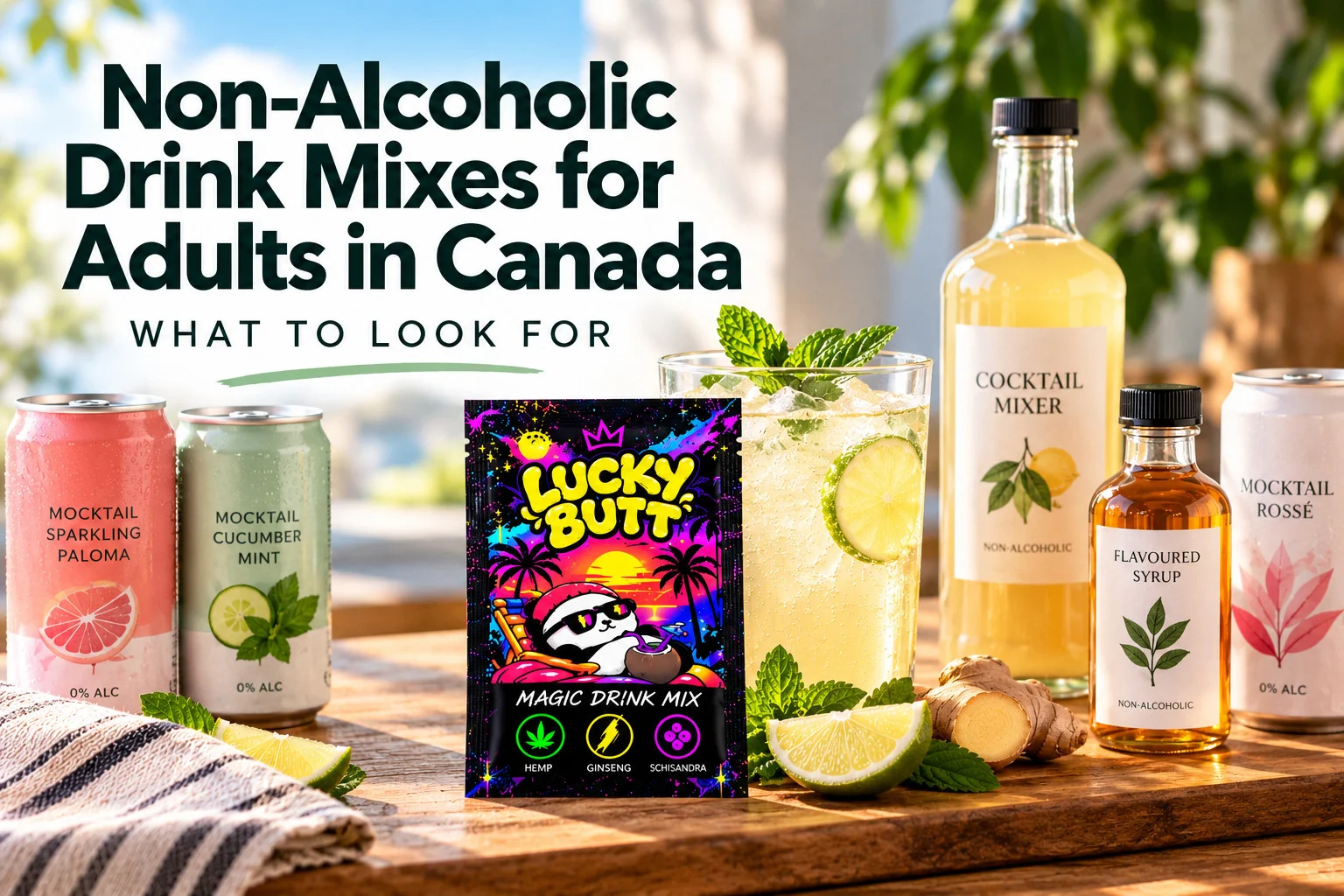
Shopping for a non-alcoholic drink mix in Canada should be simple.
You want something interesting to drink. Something that doesn't require buying a bottle of expensive fake gin, squeezing six lemons, and developing a suspiciously strong opinion about cocktail garnishes.
But search for alcohol-free drink mixes and you'll find everything from sugary margarita syrups to powdered hydration products.
Apparently, putting anything in water makes it a "drink mix" now.
So what should you actually buy?
The best non-alcoholic drink mix depends on whether you want a cocktail-style flavour, a portable single-serve option, or something completely different from traditional alcohol.
Here's how to figure that out without filling your kitchen with bottles you'll use twice.
First, What Counts as a Non-Alcoholic Drink Mix?
A non-alcoholic drink mix is an ingredient or product designed to be combined with another beverage to create a finished drink without adding alcohol.
But that description covers some very different products.
There are four main formats worth comparing.
| Drink format | What you're getting | Main advantage | Main drawback |
|---|---|---|---|
| Powdered drink packets | A dry mix added to a beverage | Compact and portable | Requires mixing |
| Bottled cocktail mixers | A liquid mixer, often cocktail-inspired | Familiar flavours | Bottles take up space |
| Concentrated syrups | A small amount of flavoured concentrate | Adjustable flavour intensity | Can be quite sweet |
| Ready-to-drink mocktails | A finished canned or bottled drink | Open and drink | Less portable in quantity |
Not every drink mix is intended to be consumed on its own.
Some bottled margarita and sour mixes, for example, are designed to be combined with spirits. A product labelled "non-alcoholic mixer" doesn't necessarily mean its suggested serving recipe is alcohol-free.
Check the instructions before assuming you're buying a complete alcohol alternative.
1. Powdered Drink Mixes: Small Packets, Big Convenience
Powdered drink mixes are probably the most overlooked format for adults who want something other than another can of soda.
They work by keeping the drink ingredients in dry form until you're ready to mix them into water or another beverage.
That means you can keep individual portions in a bag, cupboard, or desk drawer without storing an entire case of drinks.
Of course, powdered products aren't all the same.
Some are fruity and sweet. Some contain electrolytes. Others contain botanicals such as herbs, seeds, roots, and berries.
And those ingredients can create dramatically different flavours.
Choose a powdered drink mix if:
- You want a portable option.
- You prefer preparing one drink at a time.
- You don't want to store lots of bottles or cans.
- You're comfortable mixing a drink yourself.
The trade-off is texture and preparation. Not every powder dissolves completely, and some plant-based blends can leave sediment.
Read the preparation instructions and choose a flavour profile you actually enjoy.
2. Bottled Mocktail Mixers: For People Who Want Cocktail Flavours
Maybe you love a margarita, mojito, or cosmopolitan.
You just don't want the alcohol.
Bottled cocktail mixers are a logical place to start because many are designed around familiar cocktail flavours.
A bottled margarita mixer might feature lime and sweetness. A mojito mixer might combine mint and citrus.
In Canada, retailers such as Well.ca and Upside Drinks carry different kinds of cocktail mixers.
But before purchasing, check how the product is supposed to be served.
Some mixers taste good with sparkling water. Others are formulated primarily as ingredients in alcoholic cocktails.
Also check how many finished drinks a bottle makes.
A large bottle isn't necessarily better value if the recommended serving uses a substantial portion of it.
Best for: People who want familiar cocktail-inspired flavours and don't mind storing bottles.
3. Concentrated Syrups: More Control, More Decisions
Flavoured syrups are useful when you want to control how strong a drink tastes.
Add a little to sparkling water for a subtle flavour, or use more for something sweeter and more intense.
They're especially convenient for people who enjoy experimenting.
The downside?
You're doing more of the work.
You still need a base beverage, and possibly citrus, ice, or other ingredients.
Some syrups also contain substantial amounts of sugar per serving, though sugar-free and lower-sugar options exist.
Check the nutrition label rather than assuming a product is healthier because its packaging has leaves on it.
Best for: Home mocktail enthusiasts who enjoy customizing drinks.
4. Ready-to-Drink Mocktails: Convenience Without the Mixing
Technically, these aren't drink mixes.
But if you're comparing alcohol alternatives, they're worth mentioning because they're competing for the same spot in your fridge.
Ready-to-drink mocktails come prepared in cans or bottles.
There's nothing to stir, measure, or experiment with.
That convenience is their biggest advantage.
Their drawback is that you're paying for and carrying the entire finished beverage, including its water and packaging.
If you're buying one drink, that's hardly a problem.
If you're stocking up for several weeks, portability and storage might matter more.
Best for: People who value convenience above everything else.
How Much Should a Non-Alcoholic Drink Actually Cost?
Here's where things get interesting.
When comparing products, don't look only at the package price.
Compare the cost per finished serving.
A $12 bottle might sound inexpensive, but if it makes four drinks, you're spending $3 per serving.
A $20 product that makes ten drinks works out to $2 per serving.
And that doesn't account for other ingredients you may need.
Consider this illustrative comparison:
| Package | Total price | Servings | Cost per serving |
|---|---|---|---|
| Example bottled mixer | $12 | 4 | $3.00 |
| Example powdered mix | $20 | 10 | $2.00 |
| Example canned mocktail pack | $15 | 4 | $3.75 |
| Lucky Butt 10-pack | $20 | 10 | $2.00 |
The first three rows are calculation examples, not verified retail offers.
Lucky Butt's price reflects its currently listed 10-pack price in Canadian dollars.
Lucky Butt's $20 CAD price includes delivery and tax within Ontario. For other products, check shipping and taxes separately. Water, sparkling water, garnishes, and other additions can affect your final cost.
And price is only one part of value. A drink you don't enjoy isn't a bargain, no matter how cheap it is.
What About Botanical Drink Mixes?
This is where things get a little less conventional.
Botanical drink mixes use plant-derived ingredients such as herbs, roots, seeds, and berries.
Unlike traditional cocktail mixers, they're not necessarily designed to imitate a margarita or gin and tonic.
Some emphasize botanical flavours rather than familiar fruit or candy sweetness.
A good example is Lucky Butt.
It's an Ontario-based non-alcoholic powdered drink mix containing hemp, ginseng, schisandra, moringa, and ginger.
It comes in individual packets, with ten servings for $20 CAD.
The flavour is earthy, herbal, and a little zingy.
In other words, if you're expecting something that tastes like strawberry lemonade, this might not be your thing.
But if you're curious about something different, it gives you another format to consider.
Mix a packet into water or sparkling water according to the package instructions.
Lucky Butt currently ships within Ontario, Canada.
One important distinction: botanical ingredients don't automatically make a beverage an effective treatment for stress, anxiety, sleep problems, or alcohol dependence. Ingredient suitability also matters, particularly if you're pregnant, breastfeeding, taking medication, or managing a medical condition.
Choose the product for what it actually is, not for promises printed in suspiciously enthusiastic marketing copy.
What Should You Check Before Buying?
Before adding any alcohol-free mix to your cart, ask a few questions.
Does it actually contain zero alcohol?
Don't assume every product described as non-alcoholic is necessarily 0.0% alcohol.
Some alcohol-reduced or dealcoholized beverages may contain residual alcohol.
Check the product label if complete avoidance matters to you.
What does it taste like?
Words such as "botanical," "premium," and "craft" tell you surprisingly little about whether you'll enjoy a drink.
Look for a description of the actual flavour.
Is it sweet? Tart? Bitter? Earthy? Spicy?
Your taste buds deserve better than a guessing game.
How much work does it require?
Some drinks are ready immediately.
Others require a shaker, ice, sparkling water, or additional ingredients.
Neither approach is inherently better.
But a drink that fits your routine is more likely to get used than something requiring a full production crew.
What's the cost per serving?
Divide the product price by the number of finished servings.
Then account for whatever else you need to make the drink.
A low package price can be misleading if you're purchasing several other ingredients.
Are the ingredients suitable for you?
Don't assume every botanical ingredient is appropriate for everyone.
Health Canada provides information on natural health products and their ingredients. Regulatory treatment and permitted claims depend on the particular product.
Read labels and seek professional advice when necessary.
Which Non-Alcoholic Drink Format Is Best?
There's no universal winner.
If you want a margarita without the tequila, a cocktail-style mixer makes sense.
If you enjoy creating your own recipes, concentrated syrups give you flexibility.
If you want the absolute minimum effort, open a canned mocktail.
And if you're interested in keeping a few compact drink options around without storing cases of beverages, powdered mixes are worth considering.
The important thing is choosing something you'll actually want to drink.
Because replacing alcohol shouldn't mean replacing enjoyment with obligation.
You can also explore our guides to non-alcoholic drinks that aren't sweet and what to drink instead of alcohol after work if you're still figuring out what flavours and occasions suit you.
Your Drink. Your Rules.
You don't need to become a professional mixologist just to enjoy a decent non-alcoholic beverage.
Find a flavour you like. Pick a format that fits your routine. Check the ingredients. Compare the real cost.
And remember that the whole point of having alternatives is having choices.
Some days that's a fancy mocktail.
Other days it's a little packet with a ridiculous name.
Normal sucks. Your drink doesn't have to.